Cost estimating through design development and value engineering are inevitable steps in any project. When the numbers exceed the target, specialty systems like mass timber can become an obvious target, with a temptation to compare this to conventional systems.
Related News & Projects
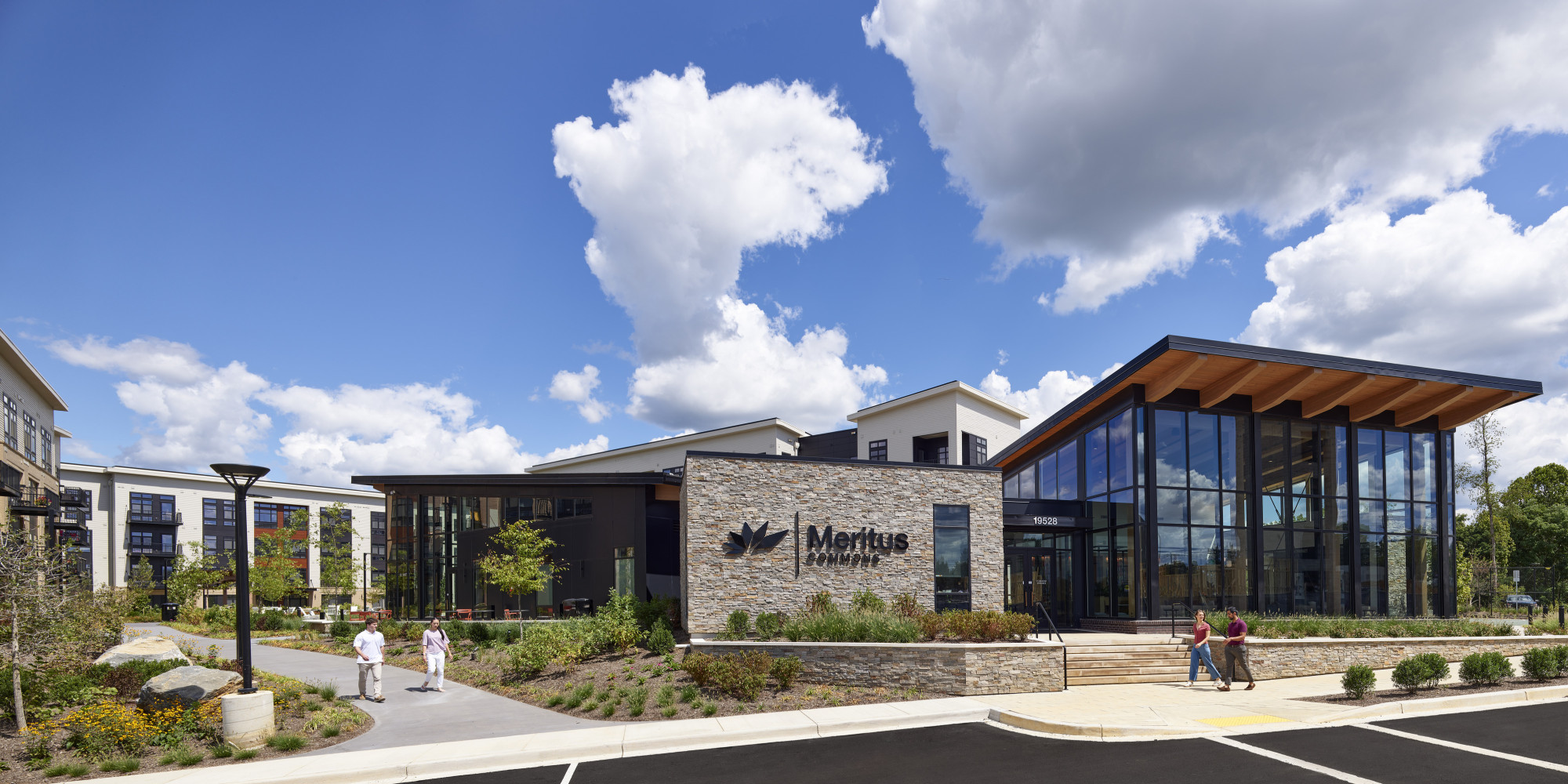
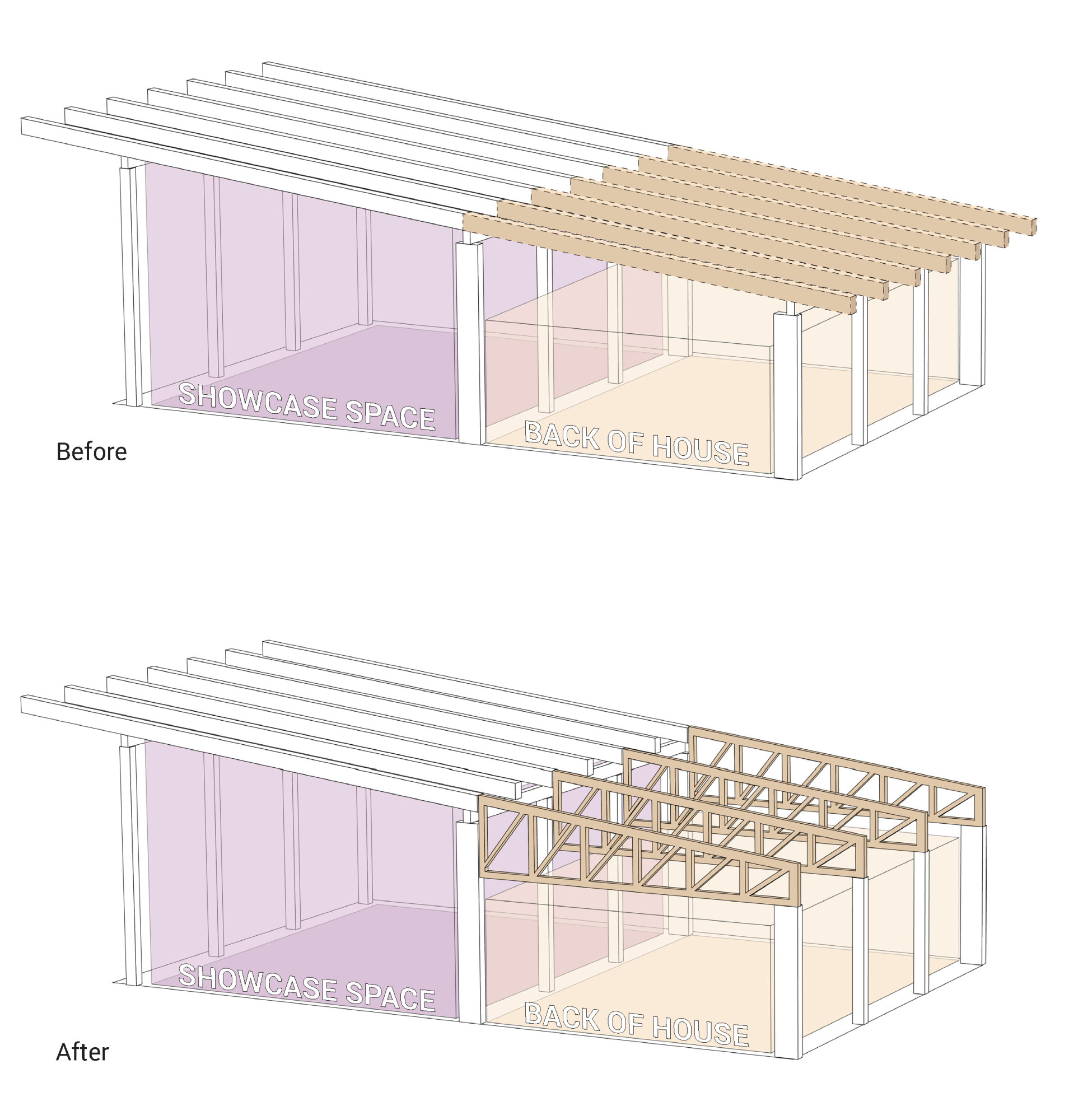
At Design Collective’s Meritus Commons project in Hagerstown, Maryland, schematic pricing came back with the overall project 5–8% over budget, and the mass timber structure for the amenity building alone accounted for 3.5% of the overall budget. Rather than treat mass timber as an all-or-nothing decision, the project team responded with a targeted value strategy, and narrowed in on the question: where does exposed timber truly carry the experience and help position the project for market competitiveness, and where is it extraneous? The answer led to a hybrid approach—keep mass timber in the areas with exposed structure and the primary public spaces, and shift the dropped-ceiling rooms to a conventional truss system. That move, along with targeted lateral support strategy, reduced the amenity building’s structural cost by 51%, which allowed the team to retain mass timber where it mattered most, while enjoying the additional fire-resistive, insulative, and low carbon benefits of mass timber1 .
1 Michael Green, The Case for Tall Wood Buildings (2017), 141.
Celebrating the Site
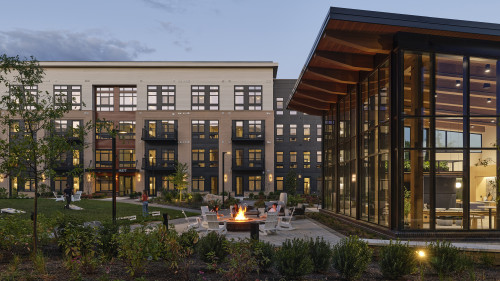
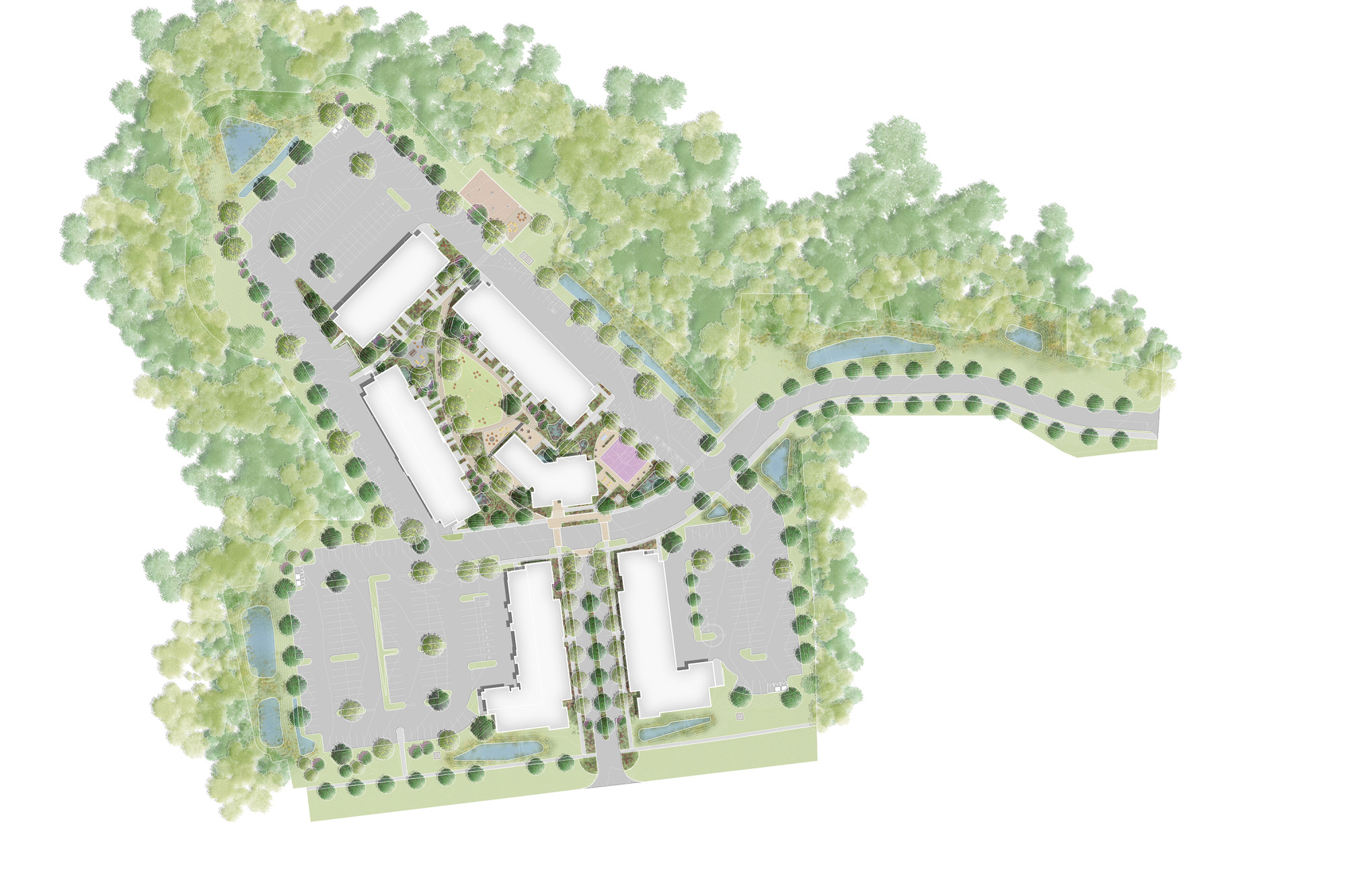
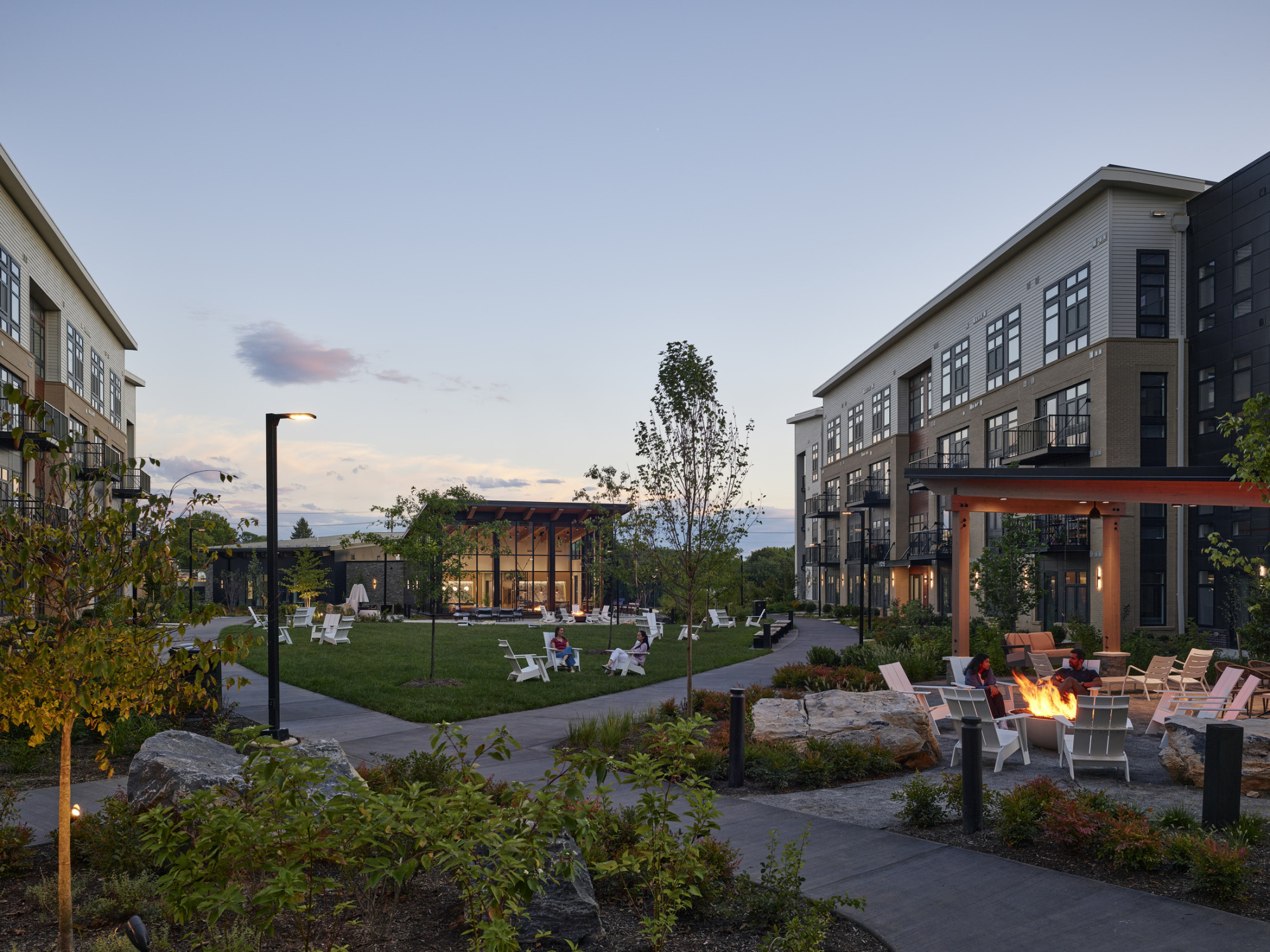
In 2023, Design Collective joined the Meritus Graduate Housing project team, led by developer Radnor Property Group, as the project’s Planner, Architect, Landscape Architect, and Interior Designer, and Graphic Designer. Located in Hagerstown, Maryland, on Meritus School of Osteopathic Medicine’s campus, this site was set in a peaceful, wooded area. The design team sought to celebrate this site and encourage residents to spend time outside, so the they arranged the project’s five apartment-style residential buildings in a way that created a generous courtyard and then nestled the central “jewel-box” amenity building into this greenspace. An emphasis on nature and indoor-outdoor connection was an important concept for this project, not just due to the site context, but also because access to nature is a wellness amenity. Much research has been done around the connection between greenspace and stress relief. One such study found that short visits to nature areas have a positive impact on stress relief proven by the reduced levels of cortisol (the stress hormone) in
study participants2. Design Collective recognized that this green, stress-relieving amenity would be important for the busy medical students living here.
2 Takahide Kagawa, et al., “The influence of urban green environments on stress relief measures: A field experiment,” Journal of Environmental Psychology 38 (2014): 1, https://doi.org/10.1016/j.jenvp.2013.12.005.
Intentionally Designing with Mass Timber
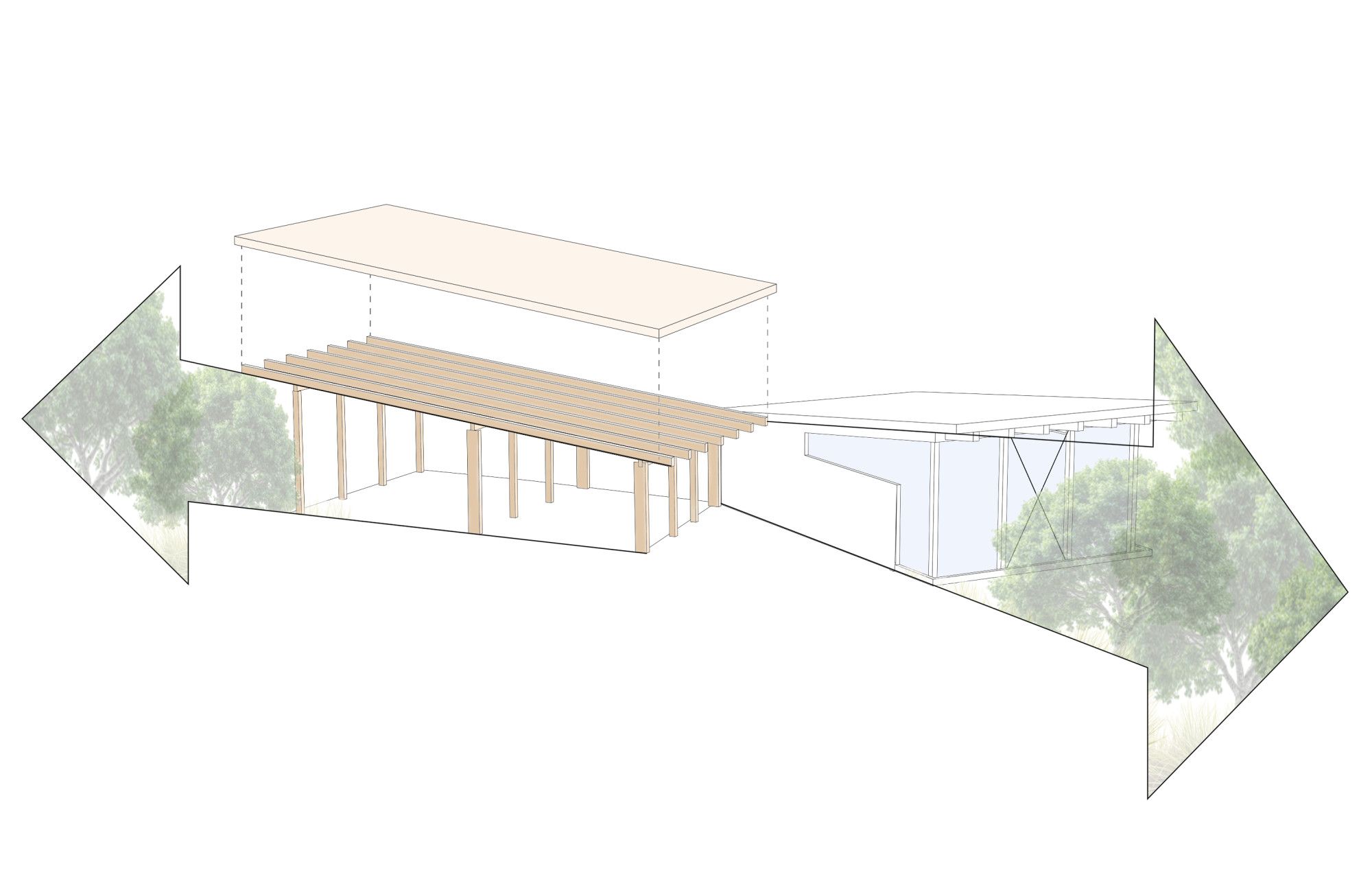
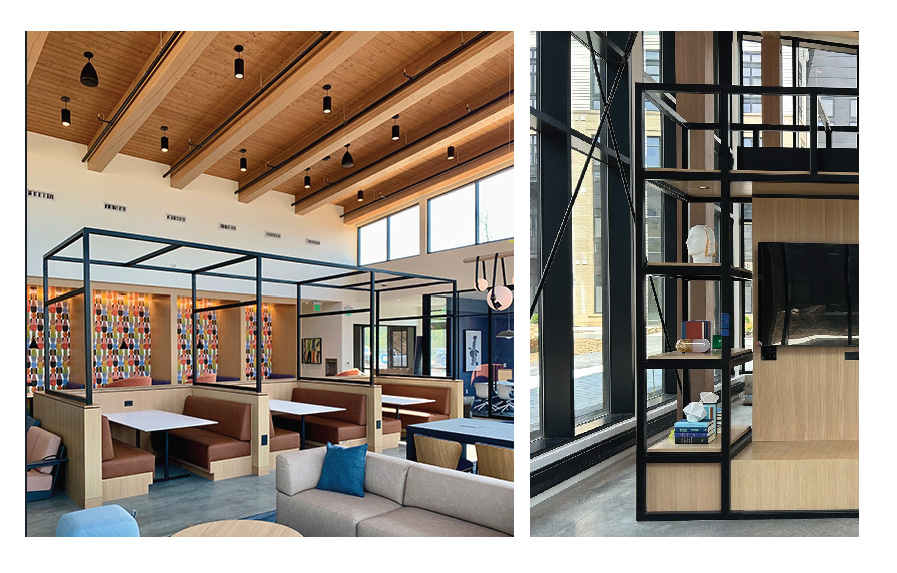
As Design Collective developed the Commons Building further, they decided to incorporate an engineered mass timber structure for three conceptual reasons. Firstly, the use of mass timber conceptually connected the building to the rural context and the wooded surroundings. Secondly, mass timber called to mind Hagerstown’s history - a town built around making, transferring and moving components across rail corridors. Mass timber is a nod to that logic of industrially fabricated components, transported, staged and assembled into a structure. Thirdly, by combining mass timber beams and an upward sloping roof line, the directionality of the exposed structure and the massing of the building guided the building users’ gaze to the surrounding greenspace, creating a strong feeling of connection to nature. The use of the mass timber members further strengthened this concept of indoor-outdoor connection, since mass timber beams can span from the interior to the exterior without a major thermal bridging issue, due to the wood beam’s lower thermal conductivity properties3.
3 Barry Braun, et al., “Impact of biophilic design on college student perception of mental health and environmental benefits: A dose-response study,” Building and Environment 267, Part C (2025): Article 112318, https://doi.org/10.1016/j.buildenv.2024.112318.
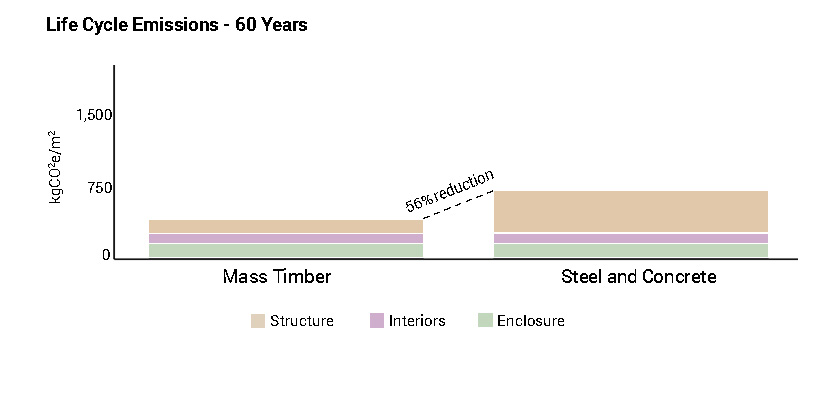
The design team also recognized three proven benefits of using mass timber. The first benefit was that wood is a biophilic material, and research shows that the addition of biophilic materials to a space can significantly improve students’ perceived indoor environmental quality and productivity4. Secondly, mass timber structure offered a reduction in the project’s embodied carbon and would allow the team to partner with a local supplier and fabricator. Using embodied carbon calculation tools, the team calculated that the use of mass timber in the commons building, as compared to concrete and steel, had the potential to reduce the carbon emissions throughout the life cycle of the building by 56%. Engineered mass timber is even more sustainable than solid heavy timber, as it maximizes material use with very low waste. Lastly, mass timber structures, in conjunction with modern fire suppression systems, can safely resist fire without being encapsulated subject to the selected code path, rating requirements, and AHJ approvals. This can reduce the overall building weight and cost while allowing the natural beauty of the mass timber to be exposed5.
4 Green, Case for Tall Wood Buildings, 141.
5 Green, Case for Tall Wood Buildings, 117.
Value Engineering to Preserve Design Intent
With all these compelling reasons in mind, the design team was confident that the use of mass timber within the amenity building would add to the success of the project. However, as the Meritus Graduate Housing project passed its first cost estimate by Morgan Keller during Schematic Design, the need for cost reductions became clear. The entire project was 5-8% over budget. The mass timber structure for the amenity building alone took up 3.5% of the budget, which meant it would be a significant cost reduction if it were to be removed from the project. Despite budget concerns, the design team knew the benefits of mass timber and its importance to the success of the commons building, so they strove to find a way to keep mass timber in the project.
After reviewing as a team, Design Collective determined that, to achieve the greatest visual impact, the mass timber structure would remain in the showcase spaces that featured grand views, prioritized program, and exposed structure. The smaller rooms with drop ceilings could then be constructed with a relatively conventional wood truss structure. This simple solution of a hybrid structural system reduced the structural cost of the amenity building by 51%. This hybrid structural system also allowed for an impactful MEP coordination opportunity. The smaller rooms with deep trusses and dropped ceilings now had ample plenum space within the roof truss to accommodate all the required mechanical systems. This allowed the floor plane to be fully free of any equipment and the building occupants to use the building’s square footage to its fullest.
It Takes a Collective: Team Coordination
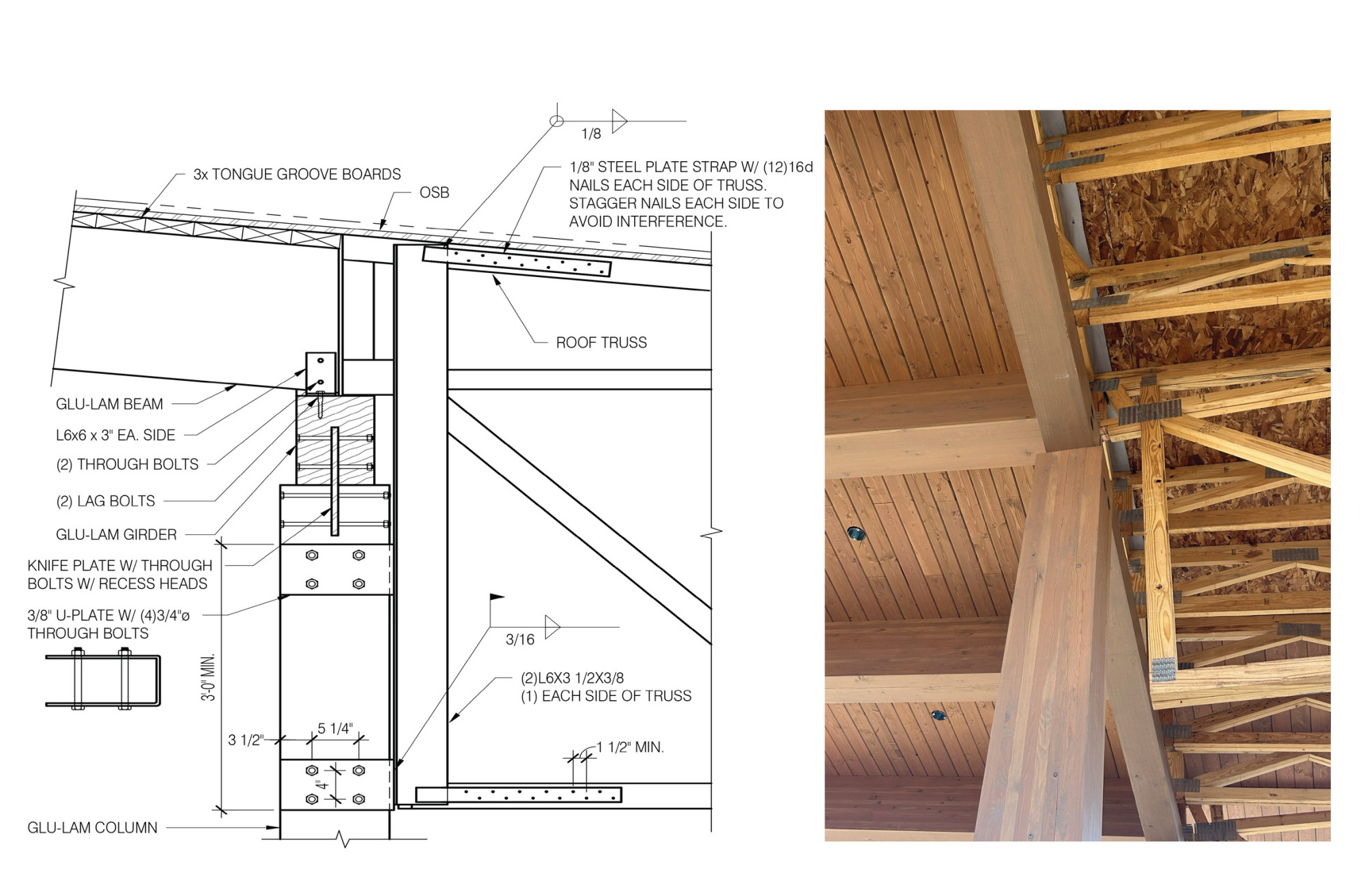
The gridline where the mass timber system met the conventional wood truss system required a specific detail to resist lateral loads. Cagley Associates, the project’s structural engineer, proposed a moment connection at this interface to avoid steel cross-bracing (the alternate approach) that would have impeded the program spaces. The solution worked structurally and architecturally, but it surfaced a predictable challenge: contractual responsibility for the interface detail.
Initially, the moment connection at the glulam column, where the mass timber beam and wood truss converged, was intended to be resolved through delegated design by the respective subcontractors, per the specifications. In practice, neither trade wanted sole liability for a detail that demanded tight coordination across scopes. The structural engineer ultimately stepped in to develop the connection, and then closely reviewed shop drawings and field installation. In the end, the success of the hybrid approach depended on shared assumptions around design intent, detailing, and sequencing, backed by clear ownership for the design and documentation of each interface.
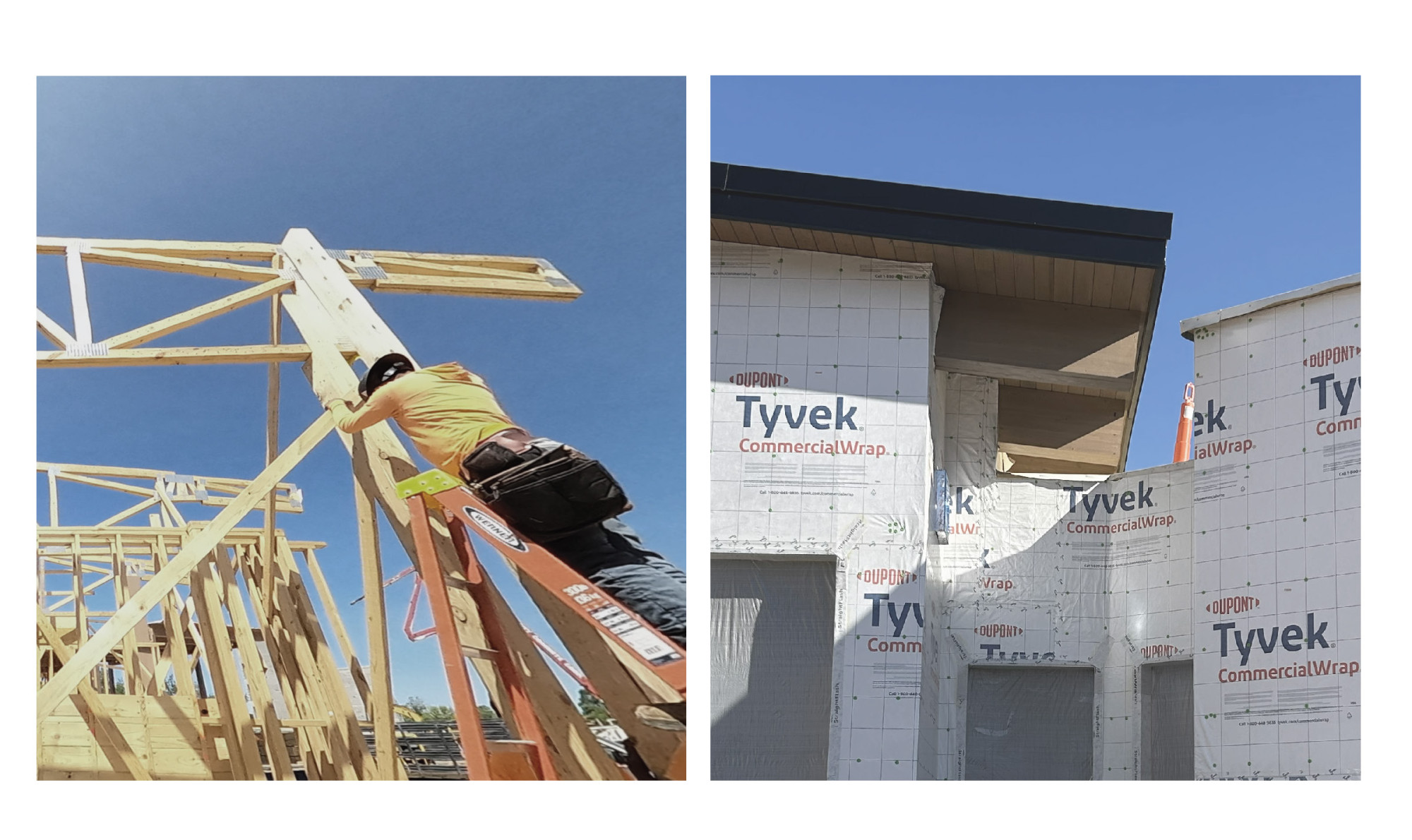
Another major coordination effort was required at the low roof edge of the building. The conceptual design called for mass timber beams running the entire length of the roof structure from the interior to the exterior, expressing through the façade at the front and back eaves. This detail was designed for both concept and performance: it reinforced the indoor–outdoor connection, supported the roof overhang, and, particularly on the south side, served as a solar shading device for the tall glazed volume during summer conditions. With the hybrid system, the low roof side transitioned to a conventional truss system in areas with dropped ceilings, making it important to maintain the extension with adequate support detailing. Cagley Associates designed a small, tapered truss to support the overhang, and Design Collective coordinated a “boxed-beam” detail as a creative solution that achieved required cost reduction while maintaining the original design intent at the eaves.
A number of MEP coordination items accompanied the use of mass timber. To preserve a clean ceiling plane and highlight the clarity of the mass timber, ductwork and diffusers were intentionally consolidated and concealed. Supply and return were located within a single bulkhead opposite the glazed walls, and, Henry Adams, mechanical engineers for the project, calibrated capacity and throw so that this distribution strategy performed effectively throughout each primary volume. Given the large spans of glazing, supplemental heating was required at the curtain wall and was detailed as a continuous, low-profile element below the glass. With no ceiling to conceal life-safety systems, sprinklers were coordinated to run parallel to the beams, and lighting was centered within each bay. Collectively, these coordination decisions kept the finished spaces calm and legible, allowing the timber structure to be visually dominant in these primary collaboration and community spaces.
Project Completion: Lessons Learned
The success of the Meritus Commons building shows that mass timber can remain in an affordability-driven project if the team is disciplined about where exposed structure matters and honest about what the hybrid approach demands. The design side is only half the story. Delivery challenges - tolerances, sequencing, and most importantly, ownership of details at the interface when systems change - cannot be overlooked. When exposed structure does not materially improve the user experience, or when procurement and code constraints narrow pathways, a more conventional system may be the better choice. In case of Meritus, the team agreed that the benefits outweighed the challenges. The commons building helps anchor the campus’s first residential community and provides a welcoming place, strengthening the value proposition for living on campus - especially when students are comparing it to off-campus market-rate options.
If you are considering a similar strategy, here are three practical takeaways:
- Treat details at systems interfaces as planned scope, not “to be figured out later.”
- Assign clear ownership early for design intent, tolerances, and sequencing at every transition.
- Use concealed zones intentionally: they can buy cost relief and simplify MEP distribution—without giving up the intended spatial experience.
Bibliography
Braun, Barry, Emma Cameron, Wendy A. DeYoung, et al. “Impact of biophilic design on college student perception of mental health and environmental benefits: A dose-response study.” Building and Environment 267, Part C (2025): Article 112318. https://doi.org/10.1016/j.buildenv.2024.112318
Green, Michael. The Case for Tall Wood Buildings. Second Edition, 2017.
Kagawa, Takahide, Kalevi Korpela, Timo Lanki, Yuko Tsunetsugu, Liisa Tyrvainen, and Ann Ojala. “The influence of urban green environments on stress relief measures: A field experiment.” Journal of Environmental Psychology 38 (2014): 1-9. https://doi.org/10.1016/j.jenvp.2013.12.005